
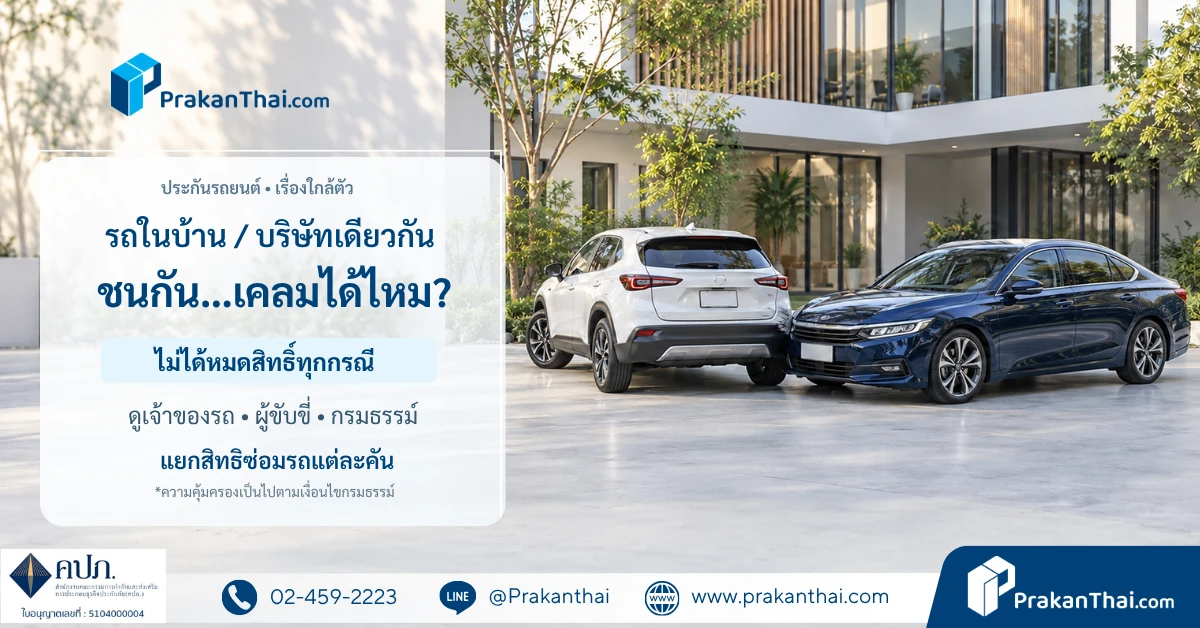
Two cars from the same household or company collide: will insurance pay?
- Published: 7 September 2026
- Category: Insurance guides
Two cars from the same household or company collide: will insurance pay?
Two cars from the same household or company collide: will insurance pay?
Answer
Parking at the same home or working at the same company is not automatically a reason for the insurer to refuse a claim, but the repair costs have to be looked at in two parts.
- Repairs to the other car: under the standard exclusions, the third-party property section of the car that caused the collision does not cover property belonging to the insured, the driver who is liable, or the spouse, parents and children of those people.
- Repairs to your own car: each car may still be able to use its own Class 1, Class 2+ or Class 3+ cover if the incident meets the conditions.
So you need to check the insured, the driver, the owner or keeper of the damaged car, and the section of cover being claimed under, not just where the collision happened.
Why might a family member's car be unable to claim from the car that hit it?
Suppose you are the insured and you reverse into your spouse's car. Your car's insurer will not pay for the repairs to your spouse's car from the third-party property section, because the car that was hit falls under the exclusion based on who owns the property. The same principle applies even if it happens on the road.
This exclusion covers property belonging to:
- The insured
- The driver who is legally liable for that incident
- The spouse, father, mother or children of anyone in the two groups above
It also includes property that these people hold in their care, control or possession. So registering the cars in different names is not enough on its own to conclude that you can claim.
A closer look: 5 common cases
This table covers only the repair costs for the other car, claimed from the third-party property section of the car that caused the collision.
| Incident | Outcome under this section |
|---|---|
| Both cars are yours, and you are the insured on the car that caused the collision | Not covered: the other car is the insured's property |
| You are the insured or the driver at fault, and you hit your spouse's, parent's or child's car | Not covered: falls under the exclusion for the relationships listed |
| Two siblings' cars collide | Needs further checking: being siblings does not on its own fall under this exclusion, but you need to look at the owner, the insured, the driver and who has possession |
| Both cars belong to the same company (juristic person), and the company is the insured on the car that caused the collision | Not covered: the other car is the insured's property |
| Two different employees' private cars collide at work | Assessed under the normal conditions: working or parking in the same place is not, on its own, grounds for refusal |
A company car hitting a director's private car has to be assessed case by case, because a limited company and its director are separate persons in law. But if the director was driving the company car, was at fault, and the car that was hit is their own, it may fall under the exclusion for the driver's property.
The principles above are drawn from the Motor Insurance Policy Interpretation Manual, pages 76–77, together with Viriyah Insurance's explanation of third-party property. The wording of this exclusion is standard under Registrar's Order No. 46/2567 (2024), so it applies to policies from every insurer.
So can Class 1, Class 2+ and Class 3+ pay to repair your own car?
Each car's entitlements must be checked separately. One car's insurer not paying for the other car's repairs does not take away the own-damage cover under the other car's policy.
| Insurance on the damaged car | Cover to repair that car after a collision |
|---|---|
| Class 1 | Generally covers own damage from an accident, unless an exclusion applies |
| Class 2+ and Class 3+ | May cover a collision with a land vehicle where the other party can be identified and the endorsement's conditions are met |
| Standard Class 2 and Class 3 | No cover for repairs to the insured car after a collision |
For Class 2+ and Class 3+, the car-to-car collision conditions must be checked against the endorsement actually attached to the policy, such as endorsement RYP.10 in the OIC standard policy form.
A simple example: you are the insured, driving a car with Class 1 cover, and you reverse into your spouse's car, which has Class 3 cover.
- Your car: you can claim the repairs under your own Class 1 policy, subject to its conditions.
- Your spouse's car: the repairs can't be claimed from your car's third-party property section because of the exclusion, and your spouse's Class 3 policy doesn't cover repairs to their own car after a collision.
This is why a household can have every car insured and still have to pay for some of the repairs itself.
If you can claim, will you still have to pay anything?
Before you agree to the repairs, check these 3 things
1. The policy's excess (deductible)
Check the amount stated in the schedule and the conditions for the type of claim. The standard THB 1,000 excess applies to damage not caused by a collision or overturning, or to a collision where the other party can't be identified, so don't assume that “hitting a post or a wall always costs THB 1,000”. A collision between household cars where the other party is identified is not a case of an unidentified other party, but another excess may still apply.
2. Whether the driver is named on the policy
If you have a named-driver policy but the person driving at the time was not on the list and was at fault, a policy with this condition may make the insured pay the first THB 6,000 of repairs to their own car and the first THB 2,000 of third-party property damage, assessed separately for each section and according to the covered damage.
This does not mean every claim costs THB 8,000, and paying an excess does not bring excluded property back into cover. If you were not at fault, the liable party is known and the insurer can recover its money, you may not have to pay the excess under that driver condition.
3. Premium and discounts at renewal
Your claims history may affect your discount and next year's premium. Have the insurer assess it against the policy form and your actual record, rather than assuming that one claim costs everyone the same discount.
For details of the excess, see the OIC standard policy form, own damage section, clause 4.
After an incident, what should you do before paying for repairs?
- Record the facts as they are: photograph the cars' positions, the damage and the registration plates, keep any camera footage, and give the name of the person who was actually driving.
- Notify each car's insurer: ask them to check both the cover for repairing that car and the liability for the other car.
- Get a clear reason before you agree: if the claim is refused or an excess is charged, ask for the section, the policy clause and the details in writing.
Don't change the driver's name or report the incident differently to get the claim through, as this can affect your rights and have legal consequences.
Frequently asked questions
If we share a surname or the same house registration, does that mean we can't claim?
Not automatically. You need to check the relationships as defined in the policy, the owner of the property, the insured, the driver, and who actually has the property in their care, control or possession.
Does insuring the cars with different insurers help you claim?
Using different insurers does not remove the property exclusion. You still need to check, separately, the right to claim from the car that caused the collision and the cover for repairs under each car's own policy.
Several cars at home or at your company? Check your cover before you end up paying yourself
Message Prakanthai.com on LINE and type “several cars”, and our team will do an initial check of your cover free of charge.
Send us the details of each car: model and year, owner, insured, insurance class and regular driver. We'll help check which car could be repaired under its own insurance if they collided with each other, and what is worth reviewing before renewal.
👉 Message LINE Official @prakanthai
📞 Call +66 2 459 2223
Serving customers since 2004, ready to explain your cover and help coordinate based on the facts.
This article covers damage to cars and property. Claims are decided according to the law, the facts, and each policy's schedule and endorsements. Injury or death must be checked against the cover separately.