
Flood-damaged car: can you claim on your insurance? How to file a claim
- Published: 5 October 2022
- Category: Insurance guides
Flood-damaged car: can you claim on your insurance? How to file a claim
Flood-damaged car: can you claim on your insurance? Check your cover and how to file a claim
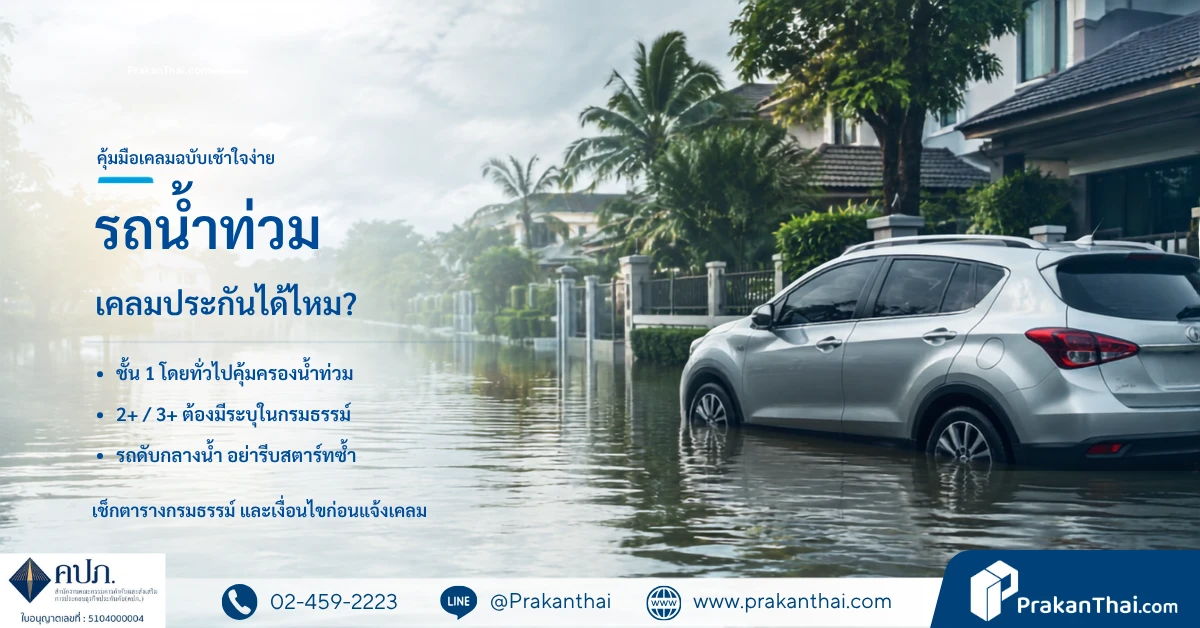
In short: You can claim for a flood-damaged car if its policy covers flood or natural disaster damage and the incident is not excluded. Class 1 car insurance generally includes this cover, while for Class 2+ and 3+ you need to check the policy schedule or endorsements plan by plan. Compulsory motor insurance (CMI) does not cover damage to the car itself.
If your car is flooded, the key thing is not to rush to start it. Record the damage, notify your insurer straight away, and wait for advice before moving or repairing the car.
Which type of car insurance covers flooding?
| Insurance type | Cover for flood damage to the car |
|---|---|
| Class 1 | Generally covers flood damage to the car, subject to the sum insured, conditions and exclusions of the policy |
| Class 2+ and 3+ | Covered only under plans that state flood or natural disaster cover in the policy schedule or an endorsement |
| Class 2 or 3 | Normally does not cover damage to the car, unless an additional flood or natural disaster endorsement is bought |
| CMI | Does not cover damage to the car, as it covers road accident victims for injury or death |
The surest way to check is to open the “policy schedule” page or your e-Policy and look for the sections on damage to the car, flood or natural disaster cover, the limit of cover and the excess (deductible). If the wording is unclear, ask your insurer or broker before anything happens.
Is a car flooded while parked different from one driven through floodwater?
If your car was parked and the water rose until it was flooded, or heavy rain caused water to flood in quickly, and your policy covers flooding, you can in principle file a claim for the insurer to assess.
If you drove into a flooded area, don't assume the insurer will refuse straight away just because the driver was “careless”. The insurer has to consider the water level, the road conditions, any warnings or road closures, the need to travel, what the driver did, what caused the damage and the policy exclusions, case by case.
However, if the water is clearly deep, the road is closed or there is another way round, stop and change your route, because pushing on may add to the damage and lead to disputes when the claim is assessed.
What should you do if your car has been flooded?
- Get out of the danger area and put safety first. Don't stay with the car if the water is rising fast or the current is strong.
- Don't start the car or try to restart it if water has got into the engine bay or cabin, or the car stalled in the water, because this may make the damage worse.
- Take photos and videos showing the registration number, the water line, the cabin, the engine bay, the surrounding area, and the date, time and location of the incident.
- Notify your insurer straight away using the claims hotline number in your policy or e-Policy, and give the registration number, policy number, location and a number to call you back on.
- Wait for advice on lifting or towing the car. If it has to be moved, use a provider suited to the type of vehicle and follow the advice of the insurer or the manufacturer.
- Don't remove, wash or repair key parts yet before the insurer or surveyor has recorded the damage, unless it is necessary for safety and you have already told them.
- Keep evidence of related costs, such as lifting or towing fees and the documents from the garage or service centre that took the car in, to send to the insurer for consideration under your cover.
What extra care do you need if your EV is flooded?
If your electric vehicle (EV) is flooded, don't start or charge it, and don't touch high-voltage cables or damaged parts. If you notice heat, smoke, an unusual smell or noises from the battery, move away and contact the emergency services. Tell your insurer and the service centre that the car is an EV so they can arrange a flatbed truck and check the high-voltage battery system properly.
Cover for an EV still depends on the policy schedule, sum insured, exclusions and each insurer's conditions, just as for any other car, but inspecting and moving it should be done by people with expertise in high-voltage electrical systems.
Does the insurer pay for repairs or pay out the sum insured?
How the insurer settles depends on the extent of the damage and the policy conditions.
- Partial damage: The insurer may arrange repairs, replace parts or pay compensation in cash as agreed and under the policy conditions.
- Total loss: The standard endorsement issued by the OIC (Office of Insurance Commission) describes this as a car that cannot be repaired to its original condition, or with damage of at least 70% of the car's value at the time of the incident. Settlement is based on the sum insured and the conditions stated in the policy.
So the water level alone does not decide whether the car will be repaired or treated as a total loss. The insurer, the garage or service centre and others involved need to assess the actual damage, especially the electrical system, control units, engine, airbag system and, in an EV, the high-voltage battery.
Documents and information to prepare when filing a claim
- Policy number or e-Policy and the registration number
- National ID card, driving licence and a copy of the registration book, as requested by the insurer
- Photos or videos of the car, the water level, the water marks and the scene
- The date, time, place and details of what actually happened
- The claim reference number or the name of the staff member who took the report
- Receipts for lifting or towing and documents from the garage or service centre
- Other documents the insurer asks for, such as a police report where necessary
Frequently asked questions
Does every Class 1 policy cover flooding?
Class 1 car insurance generally covers flood damage to the car, but always check the policy schedule, sum insured, excess (deductible), exclusions and any conditions specific to that car.
Can you claim for flooding on Class 2+ or 3+ insurance?
Only on plans that state flood or natural disaster cover. The label 2+ or 3+ on its own does not confirm that you have this cover.
If your car stalls in water, should you try starting it again?
No, don't restart it, as this may make the damage worse. Take photos, notify your insurer and wait for the car to be lifted or towed as advised.
Do you have to report a flooded car to the police?
Not every case needs a police report, so ask your insurer first. But if there was an accident, someone was injured, someone else's property was damaged, or the insurer asks for one, follow the officials' advice.
Are flood claims for EVs handled differently from other cars?
Cover is still assessed against the policy in the same way, but the safety steps, moving the car and assessing the high-voltage battery require specialists and must follow the manufacturer's advice.
How can Prakanthai.com help check and coordinate?
Before anything happens: Send your policy schedule page or e-Policy via LINE so our team can check whether you have flood cover, what the limit is and which conditions matter.
When something happens: Call the insurer's hotline stated in your policy first. Prakanthai.com customers can then send their details to ask for further coordination through claims assistance.
Contact Prakanthai
- Hotline: +66 2 459 2223
- LINE Official: @prakanthai
- Email: [email protected]
- Website: www.prakanthai.com
- Office: 88/145 Moo 7, Bang Khu Wiang, Bang Kruai, Nonthaburi 11130
- Non-life insurance broker licence no. 5104000004
Prakanthai.com helps you check your cover and understand it, with a team to help coordinate when needed.
This is a general explanation. Underwriting and claims are assessed on the facts, the policy schedule, endorsements, exclusions and the conditions of each insurer.
Reviewed by: Mr Prasert Kiatveerapat, non-life insurance broker, licence no. 5104000004
Last updated: 8 August 2026